Ososphère
Born out of the Nuits électroniques event launched in late 1990 in Strasbourg's train station district, this year's Ososphère festival brings together around fifty creations. During his opening speech at La Laiterie, which will reopen after renovations on April 24, artistic director Thierry Danet highlighted the challenges of the 2026 edition: encouraging us to “converse with the future.”
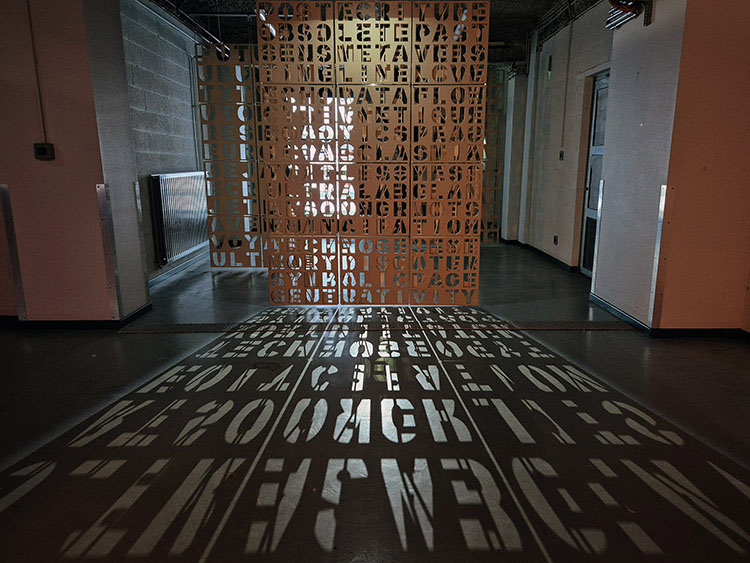
Pascal Dombis, La Fin de l’écriture, 2026.
Most of the creations on display at the Fabrique are related to techniques or technologies, and more broadly to digital cultures. At the entrance to the exhibition, Pascal Dombis' typographic installation The End of Writing includes a video and generative sequence. In the past, Dombis has already anticipated other ends, such as that of art. All human creations contain their own demise, and this has been the case for entire civilizations. On the other hand, by moving from manuscript to keyboard, then to generativity, has writing not lost some of its aura? Unless we consider that words have defeated images, at least those that they can generate using prompts. Moreover, the artist does not rule out the possibility that writing, which has constantly evolved in step with technical innovations and other societal developments, may undergo a metamorphosis. And if that were the case, we would only be at the beginning.
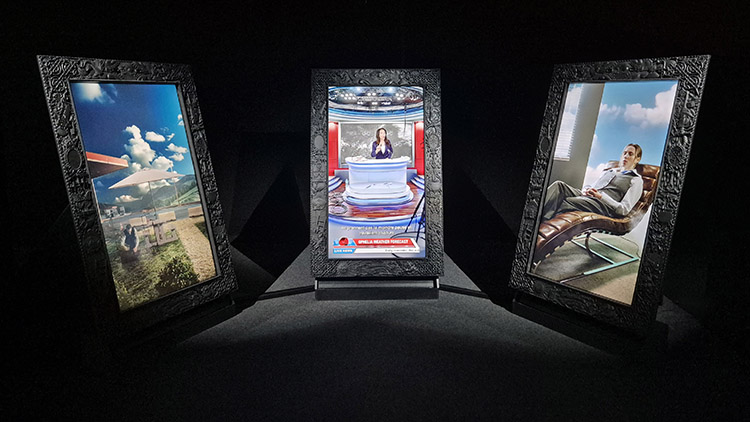
Harold Lechien, I Could Live Here Forever, 2025.
In the main room on the ground floor, where the works interact with each other, Harold Lechien's video triptych I Could Live Here Forever consists of black frames carved with ornaments that reinforce the presence of the three sequences representing three situations that sometimes overlap. The subject of this piece, produced at the Le Fresnoy National Studio of Contemporary Art in Tourcoing, is the evolution of audiovisual professions. This is due to changes in techniques ranging from green screen shooting to the use of generative artificial intelligence, as well as those that allow content to be broadcast online to the widest possible audience. As a result, the increasingly constrained performances of those who work on screen tend to take a back seat, while the democratization of technology weakens the economies associated with them.
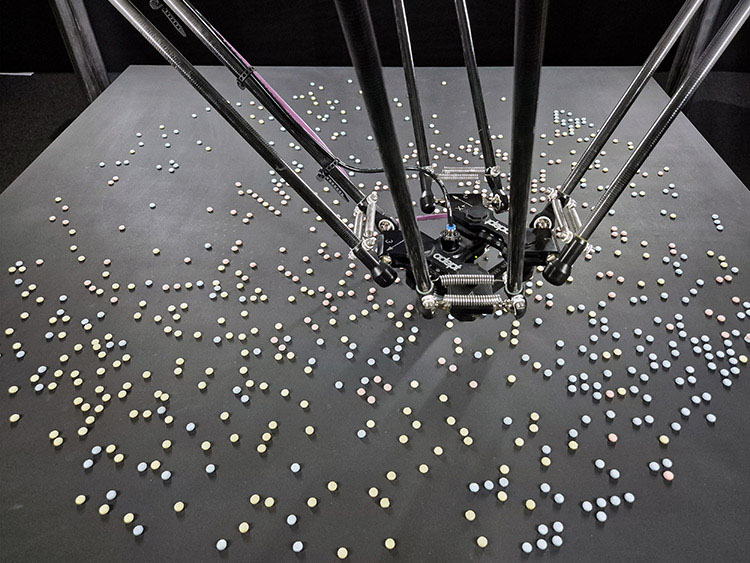
Félix Luque Sánchez, Iñigo Bilbao Lopategui, Damien Gernay & Vincent Evrard, Perpétuité II, 2023.
The gradual replacement of humans by machines is beautifully embodied by the robotic installation Perpétuité Il, designed and created by Félix Luque Sánchez in collaboration with Inigo Bilbao Lopategui, Damien Gernay, and Vincent Evrard. The industrial robot, which continuously rearranges an assortment of differently colored pills, is the center of attention. Its endless action evokes pointillism in art, although here it is the process rather than the result that constitutes the work. It is as if the machine were “incapable” of being satisfied with the representation of a single moment in time. Unless, of course, it is a perfectionist, like those artists who never finish their works, thus depriving them of any hope of an audience.
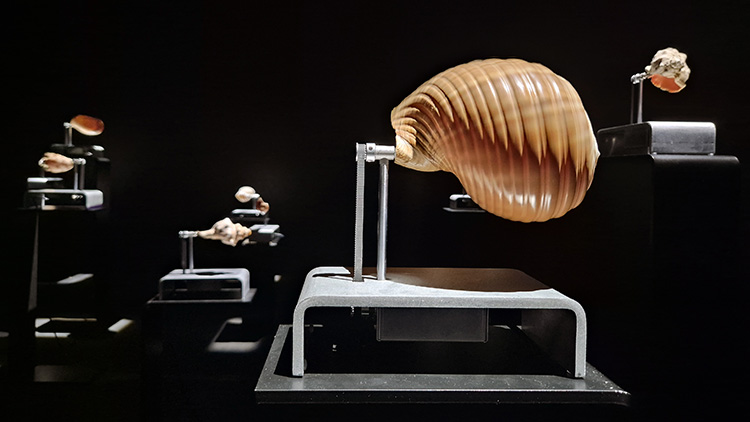
Moritz Simon Geist, Hard Times – Soft Sounds, 2021-2025.
Upstairs, among the creations that were unanimously praised at the opening, is Moritz Simon Geist's sound installation Hard Times – Soft Sounds. The title refers to the period when it was conceived, lockdown, as well as to the delicacy of the sounds it produces. The idea is simple: motorize shells containing small amounts of water that make sounds as they rotate. The lighting design is particularly well thought out for those discovering the twenty or so modules with their instrumental behavior. The sounds, repeated in space and time by the liquid movements amplified by the shells, which act as sounding boards, blend together perfectly. The multiplication of these water sounds soothes us in these difficult times.
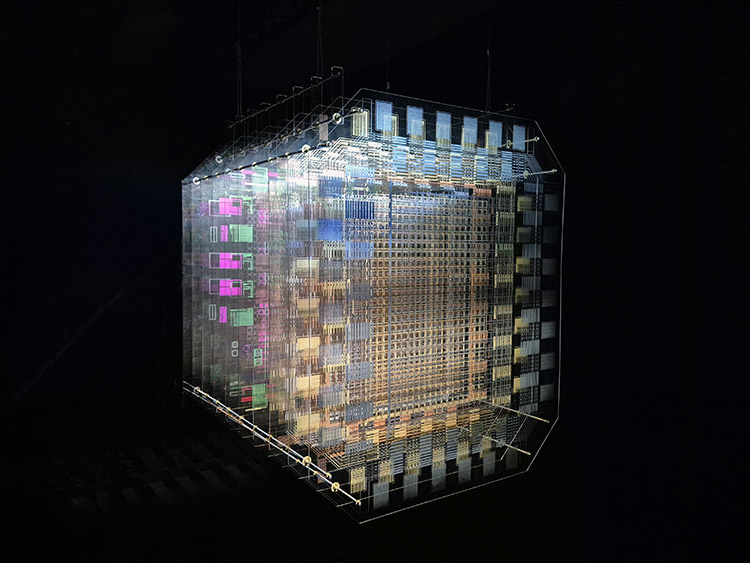
Lucien Bitaux, Micro-Strates, 2026.
Lucien Bitaux, on the other hand, embraces the complexity of his sculpture entitled Micro-Strates. It represents the layered enlargement of a technical object. The electronic component in question is the “Ultra HDR” sensor developed by the ICube laboratory at the University of Strasbourg. We are surrounded by such sensors in our daily lives, even in our pockets, without ever considering the extreme miniaturization that makes them completely imperceptible. The artist's installation, which is part of a tradition of practices combining art and science, draws our attention to this dimension where microprocessors reign supreme. These microprocessors increasingly govern our lives, even for trivial actions such as unlocking secure applications.
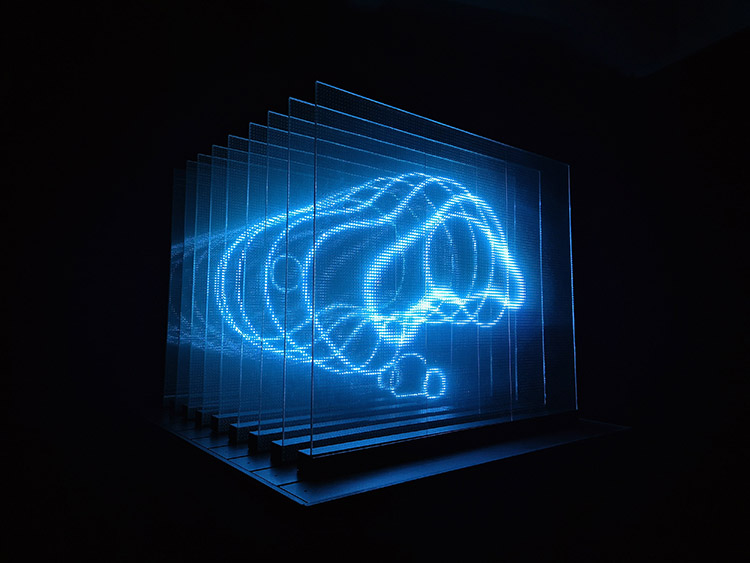
1024 Architecture, Volume, 2024.
It is interesting to note that living organisms served as a model for post-war cyberneticists, who were already interested in complex systems. This is perfectly illustrated by the sound and light installation Volume by 1024 Architecture. It is indeed a kind of luminescent blue organism that moves within the translucent plates forming a cubic sculpture on its base. The background music, occasionally interrupted by a few sound accidents, contributes to the suspense created by the virtual entity with its unpredictable movements. This form of complexity contained within the most primitive of volumes, a cube, is the signature of 1024 Architecture. The collective was founded in 2007 by Pier Schneider and François Wunschel (later joined by Nico Merlin), who remember their Nuits électroniques at La Laiterie when they were architecture students in Strasbourg. It was in this same city that it all began for the founding members of 1024 Architecture, whose studio in Paris now has an international reach. And Thierry Danet, who regularly invites them, concluded his opening speech for the Ososphère 2026 festival by referring to the legendary Haçienda club in Manchester in the 1990s with these words: “Strasbourg must be built.”
Articles
- Ars Electronica
- Art Basel
- 61st Venice Biennale
- Ososphère
- Paris Photo
- Art, technology and AI
- Immersive Art
- Chroniques Biennial
- 7th Elektra Biennial
- 60th Venice Biennial
- Endless Variations
- Multitude & Singularity
- Another perspective
- The Fusion of Possibilities
- Persistence & Exploration
- Image 3.0
- BioMedia
- 59th Venice Biennale
- Decision Making
- Intelligence in art
- Ars Electronica 2021
- Art & NFT
- Metamorphosis
- An atypical year
- Real Feelings
- Signal - Espace(s) Réciproque(s)
- On Combinations at Work
- Human Learning
- Attitudes and forms by women
- Ars Electronica 2019
- 58th Venice Biennale
- Art, Technology and Trends
- Art in Brussels
- Plurality Of Digital Practices
- The Chroniques Biennial
- Ars Electronica 2018
- Montreal BIAN 2018
- Art In The Age Of The Internet
- Art Brussels 2018
- At ZKM in Karlsruhe
- Lyon Biennale 2017
- Ars Electronica 2017
- Digital Media at Fresnoy
- Art Basel 2017
- 57th Venice Biennial
- Art Brussels 2017
- Ars Electronica, bits and atoms
- The BIAN Montreal: Automata
- Japan, art and innovation
- Electronic Superhighway
- Lyon Biennale 2015
- Ars Electronica 2015
- Art Basel 2015
- The WRO Biennale
- The 56th Venice Biennale
- TodaysArt, The Hague, 2014
- Ars Electronica 2014
- Basel - Digital in Art
- The BIAN Montreal: Physical/ity
- Berlin, festivals and galleries
- Unpainted Munich
- Lyon biennial and then
- Ars Electronica, Total Recall
- The 55th Venice Biennale
- The Elektra Festival of Montreal
- Digital practices of contemporary art
- Berlin, arts technologies and events
- Sound Art @ ZKM, MAC & 104
- Ars Electronica 2012
- Panorama, the fourteenth
- International Digital Arts Biennial
- ZKM, Transmediale, Ikeda and Bartholl
- The Gaîté Lyrique - a year already
- TodaysArt, Almost Cinema and STRP
- The Ars Electronica Festival in Linz
- 54th Venice Biennial
- Elektra, Montreal, 2011
- Pixelache, Helsinki, 2011
- Transmediale, Berlin, 2011
- The STRP festival of Eindhoven
- Ars Electronica repairs the world
- Festivals in the Île-de-France
- Trends in Art Today
- Emerging artistic practices
- The Angel of History
- The Lyon Biennial
- Ars Electronica, Human Nature
- The Venice Biennial
- Nemo & Co
- From Karlsruhe to Berlin
- Media Art in London
- Youniverse, the Seville Biennial
- Ars Electronica, a new cultural economy
- Social Networks and Sonic Practices
- Skin, Media and Interfaces
- Sparks, Pixels and Festivals
- Digital Art in Belgium
- Image Territories, The Fresnoy
- Ars Electronica, goodbye privacy
- Digital Art in Montreal
- C3, ZKM & V2
- Les arts médiatiques en Allemagne
- Grégory Chatonsky
- Le festival Arborescence 2006
- Sept ans d'Art Outsiders
- Le festival Ars Electronica 2006
- Le festival Sonar 2006
- La performance audiovisuelle
- Le festival Transmediale 2006
- Antoine Schmitt
- Eduardo Kac
- Captations et traitements temps réel
- Maurice Benayoun
- Japon, au pays des médias émergents
- Stéphane Maguet
- Les arts numériques à New York