Art Basel
When summer arrives, the contemporary art world loves to gather in Basel for its famous art fair, which this year has been expanded to include the digital section Zero 10. It’s a chance to visit some of Basel’s museums, such as the Tinguely and the Kunstmuseum, as well as other foundations like the Beyeler. And round off your evenings at the Basel Social Club, which this year has taken over a former office building near the train station.
At the Tinguely Museum
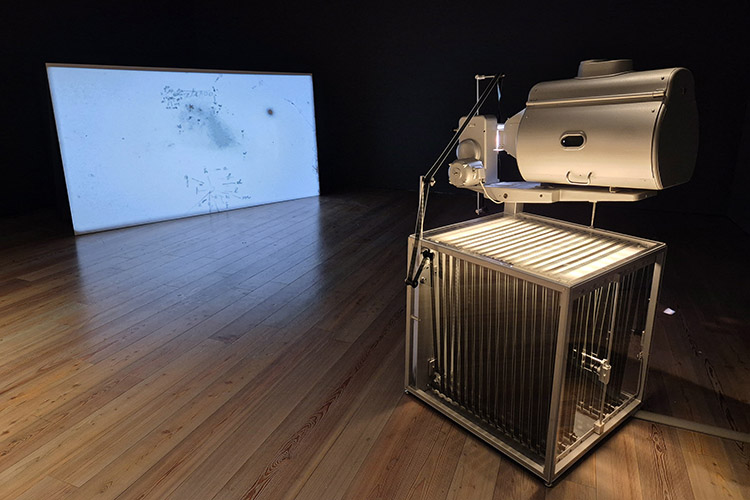
Rosa Barba, Send Me Sky, Henrietta, 2018. Courtesy Esther Schipper, Vistamare, Corbett vs Dempsey.
The museum dedicated to Tinguely also hosts temporary exhibitions such as Labouring Bodies, which explores the relationship between women’s bodies and work (in every sense of the word) and features, among other works, the installation Send Me Sky, Henrietta by Rosa Barba. The Italian artist is known for her interest in film content as well as in 16mm and 35mm projectors and celluloid film, for which she creates kinetic sculptures. Here, the projector becomes an essential component of the 2018 film and kinetic apparatus Send Me Sky, Henrietta, which focuses on the research of Henrietta Swan Leavitt (1868-1921). It was by observing images of stars like those passing before our eyes that this human computer was able to catalog the positions and brightness of stars. This enabled astronomers to measure the distances to distant stars. In fact, human computing organized into teams emerged in the 17th century, but it wasn’t until the late 19th century that the profession opened its doors to women, who played a vital role during World War II.
At the Kunstmuseum Basel Gegenwart
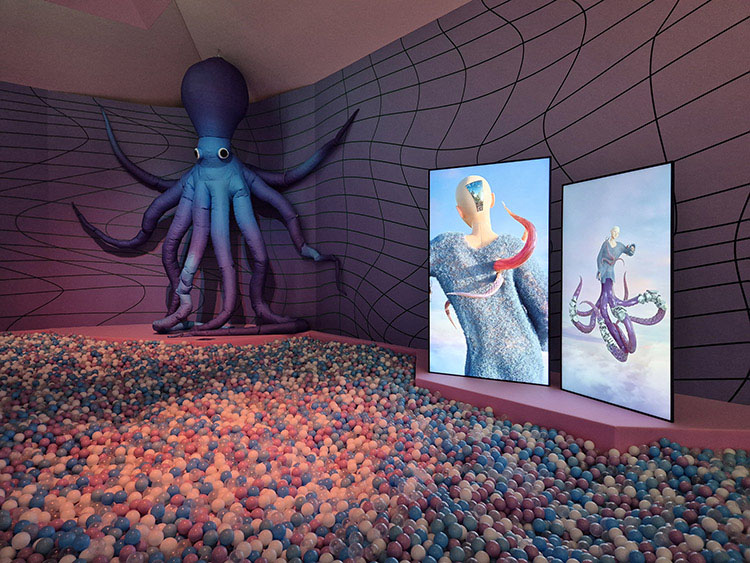
Cao Fei, Testimonies to the Near Future, 2026. Kunstmuseum Basel Gegenwart.
For its part, the Kunstmuseum Basel Gegenwart is dedicating its entire space – nearly 2,000 square meters spread over four floors – to the Chinese artist Cao Fei. The solo exhibition Testimonies to the Near Future, which spans thirty years of her work, has been conceived as a city where factory labor is juxtaposed with digital recreations that blend video games and social media. On the third level, two worlds coexist within the zones titled The Office and The Playground. The first, developed within Second Life between 2007 and 2011, revolves around the virtual universe of RMB City, where tradition and modernity merge in a changing China. The second, titled Duotopia and developed between 2022 and 2024 on a Chinese metaverse platform, features the avatar OZ: a hybrid, androgynous creature that moves freely above the clouds. Both explore the idea of a floating world, either composed of islands or suspended in space. Finally, it is worth noting that the particularly meticulous exhibition design establishes numerous points of connection between the artworks and the exhibition itself, thereby transforming the museum into a strangely liminal space.
At the Beyeler Foundation
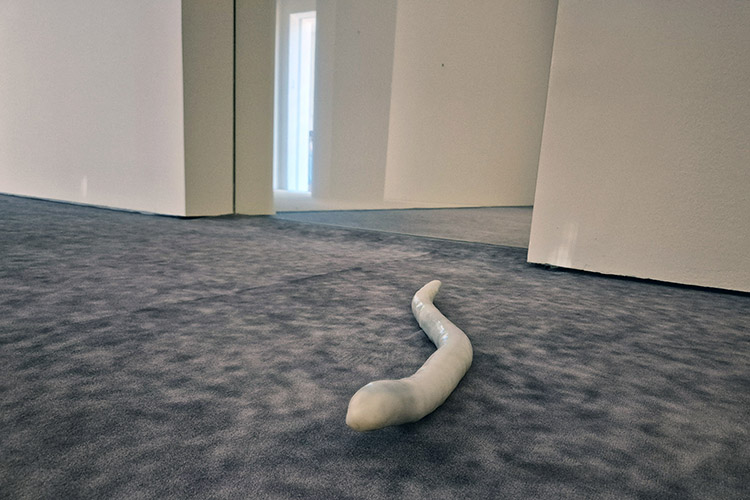
Pierre Huyghe, Alchimia, 2026.
The Beyeler Fondation main exhibition is dedicated to Pierre Huyghe, where a journey - ranging from the minute to the monumental - oscillates between the living and the inanimate using various techniques, technologies, and media. A few ants (Umwelt) at the entrance wander just as we will among sculptures, installations, and projections. Two glass walls –sometimes opaque, sometimes transparent – add a certain complexity to the exhibition space. At the threshold of one of them stands an object with the behavior of a soft robot resembling a larva, titled Alchimia. A detail of unsettling strangeness that, despite its small size and precisely because it concludes our stroll, imbues the entire exhibition with a sense of suspension between two states. The question of uncertainty is central to the work of this French artist, who punctuates his exhibitions with suggestive works that reveal only fragments of narratives, which the audience interprets and reassembles according to their own personal experiences and emotional state now.
At Art Basel
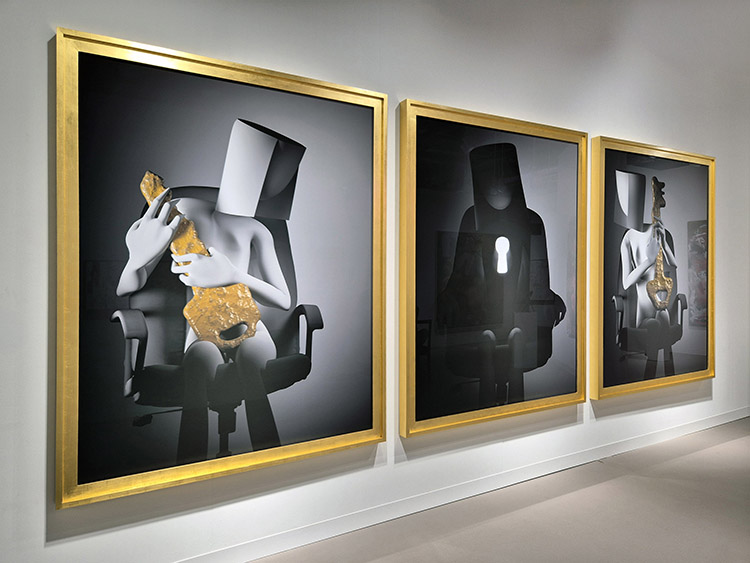
Bunny Rogers, Flanked Keyhole 2, 2026. Courtesy Société Berlin.
It’s hard to stand out among the more than 280 galleries participating in the Basel art fair. The Berlin-based Société Gallery, located on the second floor of Hall 2, does just that with Bunny Rogers’ series Flanked Keyhole 2. This emerging American artist draws inspiration from popular cultures that digital technology and the internet continue to amplify. Her framed depictions follow in the tradition of painted portraits of seated figures. Yet the predominance of grayscale tones evokes photography, while the extreme smoothing of the bodies recalls three-dimensional modeling. On the laps of the three figures, a lock in the center is flanked on either side by oversized keys whose surface treatment evokes techniques for capturing reality. But above all, these keys gleam with a sparkling gilding, which evokes the idea of a quest in video games. If this triptych were a riddle – as art history is so fond of – the formal difference between the two keys would mean that only one of them could solve it.
At Unlimited
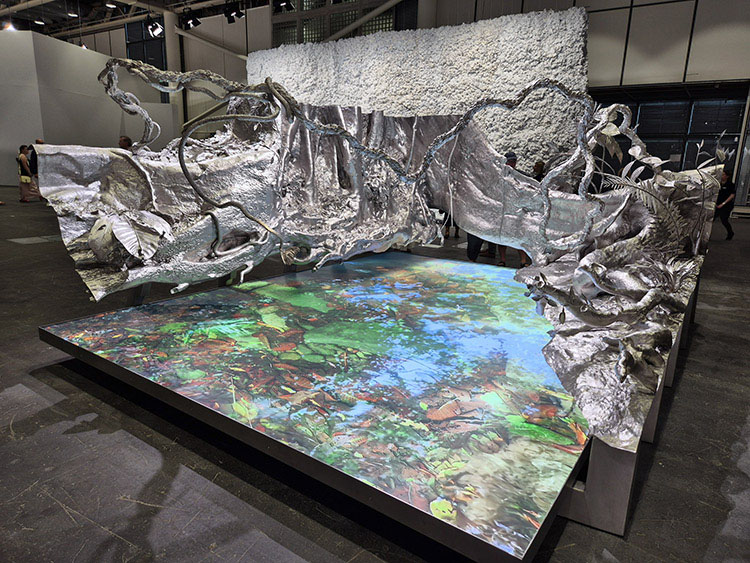
Timur Si-Qin, Mariposita, 2026. Courtesy Magician Space, Société Berlin.
In the Unlimited section of Hall 1, Société has partnered with Magician Space to present Timur Si-Qin’s large-scale installation Mariposita. With support from the Sigg Art Foundation for this project, the New York-based artist has meticulously recreated a small corner of nature found in the Peruvian Amazon rainforest. The use of a digital capture process adds an extra layer of realism to the vegetation, which is further enhanced by the silvery sheen of the metal. As for the pond at the base of the tangled Ficus trees, it is depicted by an LED screen; the movement of the water in the image transports the viewer to a peaceful, distant place, far from the clamor of the event. Thus, this reconstructed fragment of nature fulfills the role that fountains typically play in public spaces – places where people gather to reflect on the extreme fragility of so many ecosystems that nature has so perfectly created, and that we all too often disrupt without even realizing it. As for the Spanish title Mariposita, it refers to the little butterfly – a symbol of transience ¬– which is none other than one of the artwork’s sculptural details. It is as if to remind us that all living things, without any hierarchy, are necessary for biodiversity.
At Zero 10
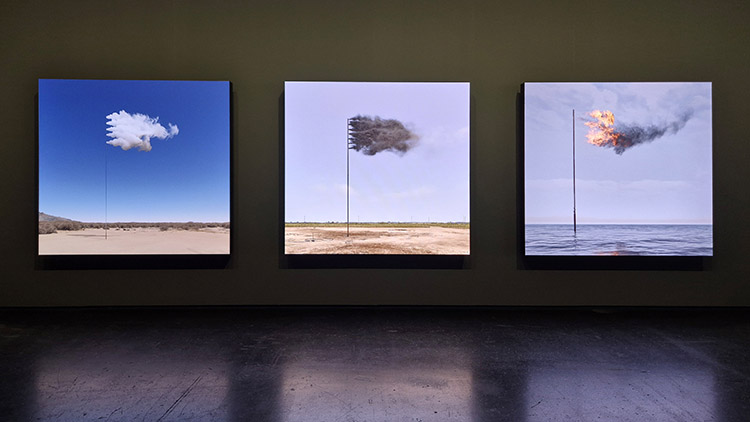
John Gerrard, Western Flag (Spindletop, Texas), 2017, Flare (Oceania), 2022, Standard, 2023. Courtesy Fellowship.
The third edition of Zero 10 took place in the Event Hall at Messeplatz. Zero 10 is a section of Art Basel – launched last year in Miami and featured in Hong Kong – dedicated to art in the digital age and supported by the Web 3 community. The Fellowship platform welcomes visitors with three square LED screens displaying three-dimensional animations of Western Flag, Flare and Standard by John Gerrard. These are three real-time simulations of flags that symbolize our current concerns. Dating from 2017 and located in the center, the first consists of thick black smoke that embodies the carbon footprint of our hydrocarbon consumption since the first gushes from the Spindletop oil field in Texas at the beginning of the last century. The second, from 2022 and on the right, evokes the continuous flaring of natural gas, while its mast is virtually located off the coast of the Tonga Islands – which, like so many other flood-prone territories, are threatened by melting polar ice. The third, from 2023, on the left, is more optimistic, as it has the whiteness of water vapor. But what kind of surrender is this in the current international geopolitical situation? For the contexts in which the artworks are received sometimes reorient their messages!
At the Basel Social Club
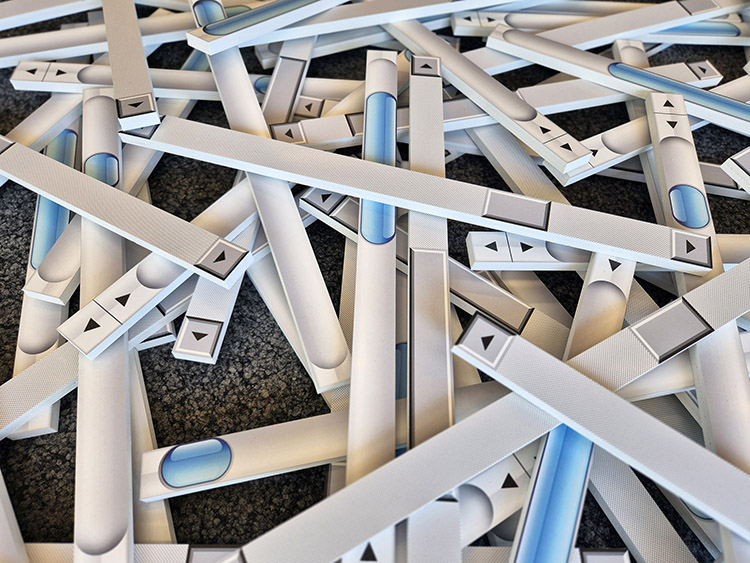
Jan Robert Leegte, Scrollbars, 2024. Courtesy Office Impart.
Finally, Berlin’s Office Impart gallery bridges the gap between the Zero 10 sector and the Basel Social Club by showcasing works by the same artist: Jan Robert Leegte. The pieces on display at both fairs are imbued with a gentle sense of nostalgia. The prints from the Sightings series, presented in collaboration with Amsterdam’s Upstream Gallery, evoke the low resolutions of early digital cameras. Although these are images without any actual subject – and thus without real subjects – that we recognize as enlargements, what constitutes the artwork is the JPEG compression, a defining feature of contemporary photography for decades. At the Basel Social Club, a stack of scroll bars from earlier versions of Apple systems (Scrollbars) symbolizes the time we spend interacting with our interfaces. It is indeed the scroll bar that allows us to travel back in time, through the flow of our memories via the images we share with the world. This is what the Dutch artist does by magnifying the interfaces more than the content itself. The medium has become the message, just as Marshall McLuhan predicted in 1964, at the dawn of electronic practices that foreshadowed the digital trends in art that the market is finally taking seriously.
Articles
- Ars Electronica
- Art Basel
- 61st Venice Biennale
- Ososphère
- Paris Photo
- Art, technology and AI
- Immersive Art
- Chroniques Biennial
- 7th Elektra Biennial
- 60th Venice Biennial
- Endless Variations
- Multitude & Singularity
- Another perspective
- The Fusion of Possibilities
- Persistence & Exploration
- Image 3.0
- BioMedia
- 59th Venice Biennale
- Decision Making
- Intelligence in art
- Ars Electronica 2021
- Art & NFT
- Metamorphosis
- An atypical year
- Real Feelings
- Signal - Espace(s) Réciproque(s)
- On Combinations at Work
- Human Learning
- Attitudes and forms by women
- Ars Electronica 2019
- 58th Venice Biennale
- Art, Technology and Trends
- Art in Brussels
- Plurality Of Digital Practices
- The Chroniques Biennial
- Ars Electronica 2018
- Montreal BIAN 2018
- Art In The Age Of The Internet
- Art Brussels 2018
- At ZKM in Karlsruhe
- Lyon Biennale 2017
- Ars Electronica 2017
- Digital Media at Fresnoy
- Art Basel 2017
- 57th Venice Biennial
- Art Brussels 2017
- Ars Electronica, bits and atoms
- The BIAN Montreal: Automata
- Japan, art and innovation
- Electronic Superhighway
- Lyon Biennale 2015
- Ars Electronica 2015
- Art Basel 2015
- The WRO Biennale
- The 56th Venice Biennale
- TodaysArt, The Hague, 2014
- Ars Electronica 2014
- Basel - Digital in Art
- The BIAN Montreal: Physical/ity
- Berlin, festivals and galleries
- Unpainted Munich
- Lyon biennial and then
- Ars Electronica, Total Recall
- The 55th Venice Biennale
- The Elektra Festival of Montreal
- Digital practices of contemporary art
- Berlin, arts technologies and events
- Sound Art @ ZKM, MAC & 104
- Ars Electronica 2012
- Panorama, the fourteenth
- International Digital Arts Biennial
- ZKM, Transmediale, Ikeda and Bartholl
- The Gaîté Lyrique - a year already
- TodaysArt, Almost Cinema and STRP
- The Ars Electronica Festival in Linz
- 54th Venice Biennial
- Elektra, Montreal, 2011
- Pixelache, Helsinki, 2011
- Transmediale, Berlin, 2011
- The STRP festival of Eindhoven
- Ars Electronica repairs the world
- Festivals in the Île-de-France
- Trends in Art Today
- Emerging artistic practices
- The Angel of History
- The Lyon Biennial
- Ars Electronica, Human Nature
- The Venice Biennial
- Nemo & Co
- From Karlsruhe to Berlin
- Media Art in London
- Youniverse, the Seville Biennial
- Ars Electronica, a new cultural economy
- Social Networks and Sonic Practices
- Skin, Media and Interfaces
- Sparks, Pixels and Festivals
- Digital Art in Belgium
- Image Territories, The Fresnoy
- Ars Electronica, goodbye privacy
- Digital Art in Montreal
- C3, ZKM & V2
- Les arts médiatiques en Allemagne
- Grégory Chatonsky
- Le festival Arborescence 2006
- Sept ans d'Art Outsiders
- Le festival Ars Electronica 2006
- Le festival Sonar 2006
- La performance audiovisuelle
- Le festival Transmediale 2006
- Antoine Schmitt
- Eduardo Kac
- Captations et traitements temps réel
- Maurice Benayoun
- Japon, au pays des médias émergents
- Stéphane Maguet
- Les arts numériques à New York