Ars Electronica
Reinventing itself at various venues throughout the city of Linz, Austria, since 1979, the Ars Electronica art and technology festival examines societal changes each year. By titling the 2026 edition “Negotiating Humanity – Future Begins,” its artistic director, Gerfried Stocker, puts humanity back at the center of the debates sparked by artificial intelligence.
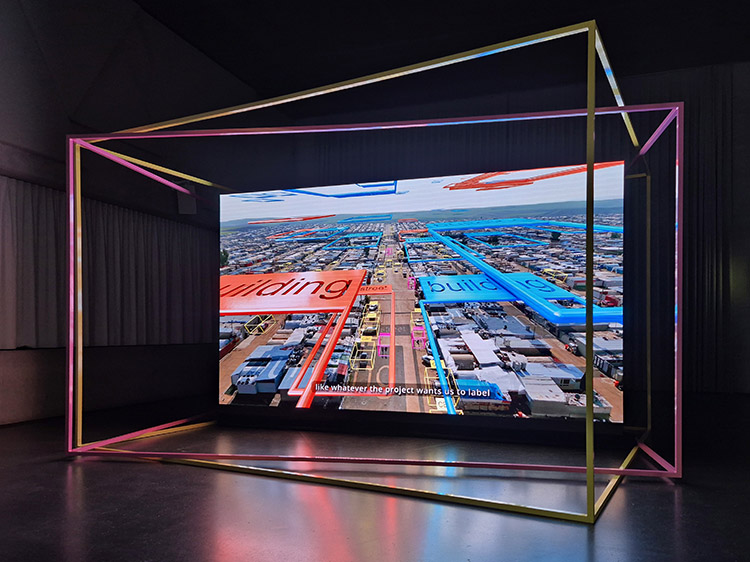
Hito Steyerl, Mechanical Kurds, 2025.
The Ars Electronica festival centers around awards whose categories have evolved since 1987, and Hito Steyerl has been awarded the STARTS Artistic Exploration prize for her work Mechanical Kurds. The installations by this German artist often share the characteristic of extending beyond the projected image, as is the case here at the Lentos Kunstmuseum. Within the exhibition space, the colorful metal structures resemble the markers used by click workers—who earn meager wages–in the Global South to train the artificial intelligence models of our digital services. The action in this documentary fiction takes place in Erbil (Iraqi Kurdistan), as the title suggests; it also refers to the 18th-century Turkish automaton, which we now know concealed a chess player inside the cabinet that served as its table. So there are still humans behind AI–even, and perhaps especially, anonymous individuals performing alienating tasks so that seemingly omniscient synthetic voices can respond to our every whim.
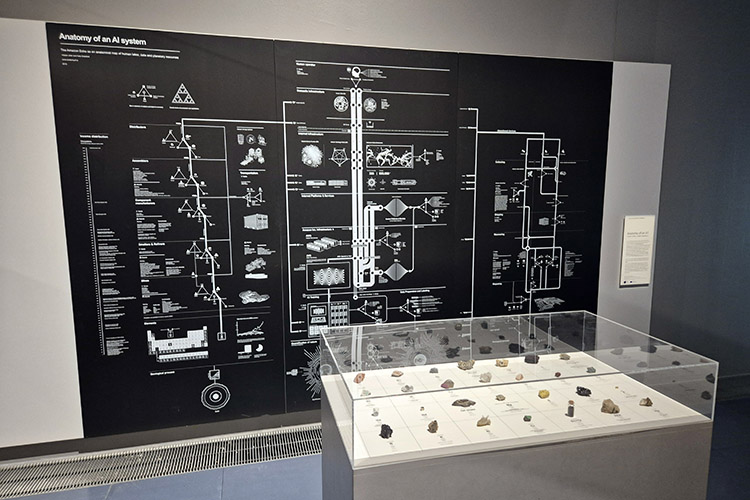
Kate Crawford & Vladan Joler, Anatomy of an AI System, 2018.
It was from the Ars Electronica festival that the center of the same name emerged in 1996, a center dedicated to exploring visions of the future. In its main gallery, there is another installation that also reveals the invisible aspects of artificial intelligence. Titled Anatomy of an AI System, it was conceived and created by Australian artist Kate Crawford and Serbian artist Vladan Joler. Engaged in both art and research, the two artists create documentary works that allow us to visualize–in this case–the components of an Amazon smart speaker, from the extraction of the minerals needed for its operation in Central Africa to the electronic waste dumps of South Asia. Everything is there, from the minerals displayed in a showcase to the manufacturing processes depicted through illustrations and captions in negative on a black background. This helps us grasp the social and environmental implications inherent in artificial intelligence, which is surreptitiously infiltrating our everyday digital environments.
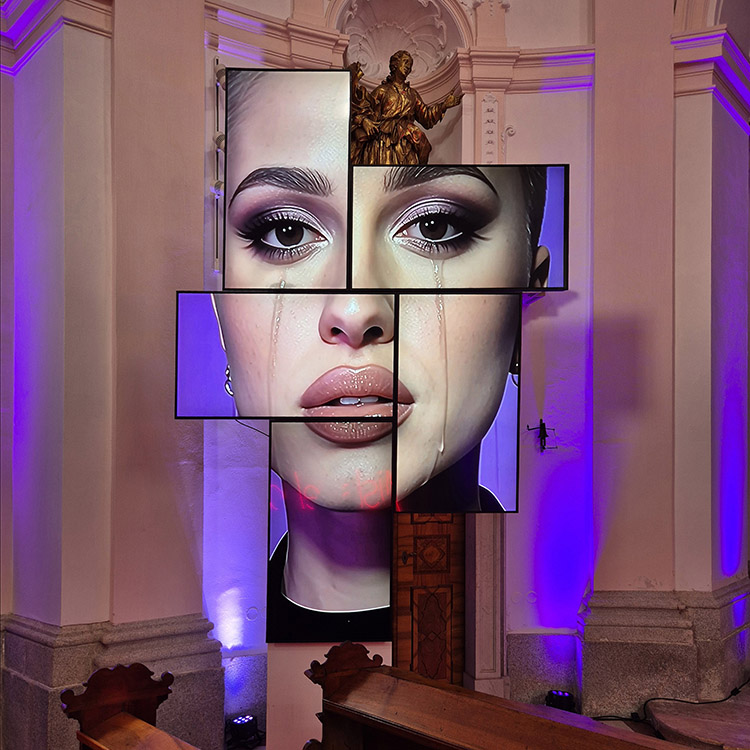
!Mediengruppe Bitnik, Qwen Stefani Against Techfascism, 2025.
This year, Ars Electronica is taking place primarily in the OK Platz neighborhood across about ten venues, such as the seminary church, where the duo !Mediengruppe Bitnik in both Zurich and Berlin—is presenting its light-based video installation Qwen Stefani Against Techfascism. She is a virtual influencer whose name references both a family of large language models and the pop star who is currently promoting a Catholic app. She weeps, just as professional mourners have feigned grief since ancient times. But she is also on a mission to inspire us to fight against technofascism, which lies at the intersection of political and technological power. To this end, she draws inspiration from the Simple Sabotage Field Manual, published in the United States in 1944 and currently enjoying a resurgence of interest at a time when social media and artificial intelligence are undermining our democracies with advice or questions such as: “Leave your phone at home and take a book instead” or “How could you sabotage a system that constantly demands your attention?”
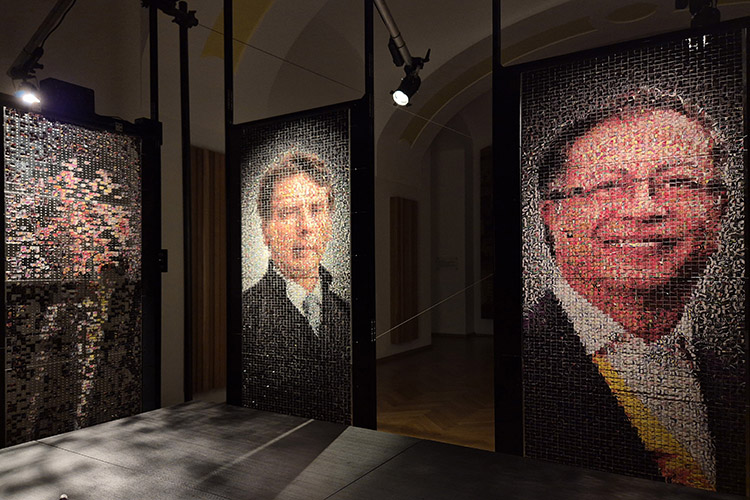
Paolo Almario, Marmelade : La Cène, 2026.
As part of the OK Quarter exhibition, another installation–this one robotic–won the State of the ART(ist) Award. It is titled Marmelade–by the Colombian-Canadian artist Paolo Almario–a term that also refers to political corruption in Colombia. The Last Supper, presented in various ways depending on the exhibition, is the third version of this work. Portraits of figures who persecuted the artist’s father (former politician Luis Fernando Almario Rojas) face us. Behind them, machines are gradually destroying the photomosaic faces composed of a myriad of Colombian jam labels. Littered with these puzzle pieces, the floor of the Elisabethinen Hospital perfectly symbolizes the elements of cases that, having been fabricated from scratch, ultimately collapse. For while the former politician proclaims his innocence, his son, the artist, sees these legal proceedings as a political conspiracy and deconstructs the faces embodying the power of a country that, weakened by decades of armed conflict, continues its reconstruction.
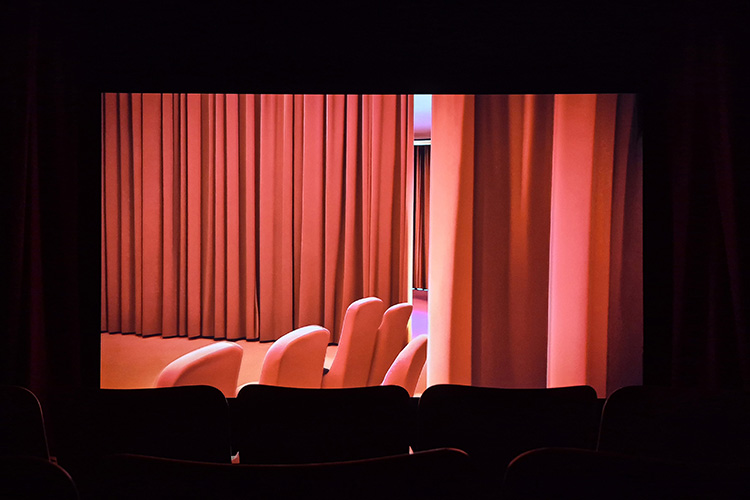
Claudia Larcher, The End, 2025.
The festival’s itinerary continues nearby at the Francisco Carolinum Linz, which is hosting, among other things, the solo exhibition No applause. No life. No pain by Austrian artist Claudia Larcher. Curator Eva Fischer describes it as “a panorama of change: the extinction of species, the erosion of shared cultural spaces, and the transformation of our perception in the age of generative AI” The exhibition is organized into themed rooms, including one dedicated to cinema. At the entrance, visitors discover the three-dimensional collages from a series titled Baumeister, begun in 2011, which draws on architecture magazines to create hybridizations of movie theater exteriors and interiors. Stepping into the room with its red velvet seats is like raising the curtain of the same color to reveal a spectacle dedicated to the highly technical art of cinema. Paper, scissors, and glue have been replaced by data sets, algorithms, and generative AI models. In the film The End, the red curtain becomes a recurring element, where cinematography techniques blend with those of projection in an art form whose technologies continue to shape both creative and societal transformations–a process that the Ars Electronica festival has been documenting tirelessly since its inception.
Articles
- Ars Electronica
- Art Basel
- 61st Venice Biennale
- Ososphère
- Paris Photo
- Art, technology and AI
- Immersive Art
- Chroniques Biennial
- 7th Elektra Biennial
- 60th Venice Biennial
- Endless Variations
- Multitude & Singularity
- Another perspective
- The Fusion of Possibilities
- Persistence & Exploration
- Image 3.0
- BioMedia
- 59th Venice Biennale
- Decision Making
- Intelligence in art
- Ars Electronica 2021
- Art & NFT
- Metamorphosis
- An atypical year
- Real Feelings
- Signal - Espace(s) Réciproque(s)
- On Combinations at Work
- Human Learning
- Attitudes and forms by women
- Ars Electronica 2019
- 58th Venice Biennale
- Art, Technology and Trends
- Art in Brussels
- Plurality Of Digital Practices
- The Chroniques Biennial
- Ars Electronica 2018
- Montreal BIAN 2018
- Art In The Age Of The Internet
- Art Brussels 2018
- At ZKM in Karlsruhe
- Lyon Biennale 2017
- Ars Electronica 2017
- Digital Media at Fresnoy
- Art Basel 2017
- 57th Venice Biennial
- Art Brussels 2017
- Ars Electronica, bits and atoms
- The BIAN Montreal: Automata
- Japan, art and innovation
- Electronic Superhighway
- Lyon Biennale 2015
- Ars Electronica 2015
- Art Basel 2015
- The WRO Biennale
- The 56th Venice Biennale
- TodaysArt, The Hague, 2014
- Ars Electronica 2014
- Basel - Digital in Art
- The BIAN Montreal: Physical/ity
- Berlin, festivals and galleries
- Unpainted Munich
- Lyon biennial and then
- Ars Electronica, Total Recall
- The 55th Venice Biennale
- The Elektra Festival of Montreal
- Digital practices of contemporary art
- Berlin, arts technologies and events
- Sound Art @ ZKM, MAC & 104
- Ars Electronica 2012
- Panorama, the fourteenth
- International Digital Arts Biennial
- ZKM, Transmediale, Ikeda and Bartholl
- The Gaîté Lyrique - a year already
- TodaysArt, Almost Cinema and STRP
- The Ars Electronica Festival in Linz
- 54th Venice Biennial
- Elektra, Montreal, 2011
- Pixelache, Helsinki, 2011
- Transmediale, Berlin, 2011
- The STRP festival of Eindhoven
- Ars Electronica repairs the world
- Festivals in the Île-de-France
- Trends in Art Today
- Emerging artistic practices
- The Angel of History
- The Lyon Biennial
- Ars Electronica, Human Nature
- The Venice Biennial
- Nemo & Co
- From Karlsruhe to Berlin
- Media Art in London
- Youniverse, the Seville Biennial
- Ars Electronica, a new cultural economy
- Social Networks and Sonic Practices
- Skin, Media and Interfaces
- Sparks, Pixels and Festivals
- Digital Art in Belgium
- Image Territories, The Fresnoy
- Ars Electronica, goodbye privacy
- Digital Art in Montreal
- C3, ZKM & V2
- Les arts médiatiques en Allemagne
- Grégory Chatonsky
- Le festival Arborescence 2006
- Sept ans d'Art Outsiders
- Le festival Ars Electronica 2006
- Le festival Sonar 2006
- La performance audiovisuelle
- Le festival Transmediale 2006
- Antoine Schmitt
- Eduardo Kac
- Captations et traitements temps réel
- Maurice Benayoun
- Japon, au pays des médias émergents
- Stéphane Maguet
- Les arts numériques à New York